Olinka roofleaf roof
The Color PurpleThe Olinka roofleaf roof is more than a covering for a hut: in Nettie’s account, it embodies a sacred relationship between the people of Olinka Village, their land, and the conditions that sustain life. At a welcome ceremony attended by Nettie, Celie, and the children, the villagers tell how a chief’s greed depleted the growth of the material, leaving the community exposed to years of destruction and death. When the roofs are restored, the people celebrate and honor the Olinka roofleaf roof as something through which the divine can be encountered.
Material Shelter and Communal Life
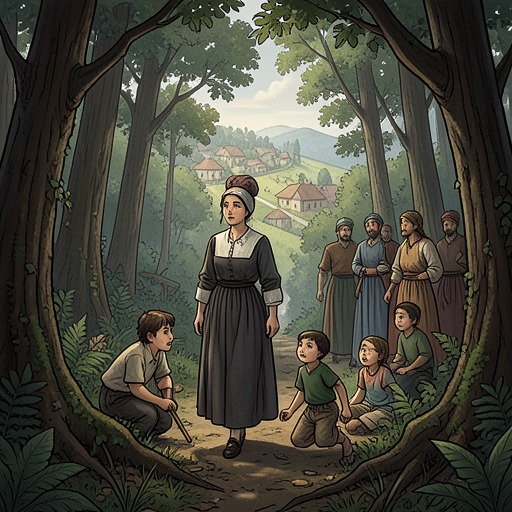
The ceremony makes the Olinka roofleaf roof tangible before it explains its sacred history. Nettie and her companions arrive around four o’clock and sit beneath a leaf canopy until nine. They eat chicken and groundnut stew with their fingers, while songs and dances raise dust around them. Little brown clay glasses have already been put into their hands, and their nervousness makes them sip. These ordinary acts of welcome—eating, listening, and sitting together—place the roof story within a shared gathering rather than apart from village life.
The story’s practical stakes are inseparable from the material itself. The villagers depend on the growth used to roof their huts, and the ceremony culminates in the arrival of an actual roof. Nettie sees a large, brown, spiky structure, as big as a room, moving slowly on a dozen legs beneath it. The villagers present it to the visitors; as it approaches, the people bow. The roof is thus not merely described as an emblem: the community brings it into the ceremony as a physical presence, making shelter visible and worthy of reverence.
The Story of Greed and Loss
As Joseph interprets the ceremony, a villager recounts how the community’s dependence on the Olinka roofleaf roof was endangered. The people believed they had always lived on the same ground, a place that provided abundant crops: cassava, groundnuts, yams, cotton, and millet. A chief wanted a larger share of land so that he could grow surplus crops for trade with white men on the coast. He gradually took more common land and more wives to work it, then cultivated the ground where the roofing material grew.
The women tried to complain about the chief’s actions, but their objections were dismissed. The elders, too, were eventually troubled by how much land he had taken. Instead of restoring what had been appropriated, the chief bought them off with axes, cloth, and cooking pots obtained from coastal traders. The account therefore makes the roof’s disappearance a consequence of political and economic choices: shared land and a resource essential to village life are converted into the chief’s private advantage and traded wealth.
A storm during the rainy season exposes the cost of that loss. After the huts’ roofs are destroyed, the villagers discover that cassava, millet, and groundnuts have replaced the once-abundant growth. For six months, rain cuts at the mud walls; fierce wind blows rocks into cooking pots, and cold stones fall from the sky, striking adults and children and bringing fever. The children fall ill first, then their parents. By the end of the rainy season, half the village is gone.
Recovery, Judgment, and Ritual
When the rains stop, the villagers search the old beds for roots. Only a few dozen remain where there had once been seemingly endless growth. It takes five years for the material to become plentiful again, and those years bring further loss: more villagers die, some leave and never return, some are eaten by animals, and many become sick. The chief is stripped of his store-bought utensils and forced to leave the village forever; his wives are given to other men. The story’s judgment of him is therefore expressed through consequences as well as punishment: the resources he tried to control cannot protect the community once their common basis has been destroyed.
The recovery does not erase that history. When all the huts again have roofs made from the Olinka roofleaf, the villagers sing, dance, and retell the account. Their celebration binds restoration to remembrance: the roof matters not simply because it has returned, but because the community has learned what its absence means. The ceremony makes the Olinka roofleaf roof a focus of worship, joining the material necessities of housing to a shared account of loss, survival, and responsibility.
Sacred Meaning and Narrative Significance
Joseph explains that an earlier white missionary would not allow the ceremony, although the Olinka value it. He distinguishes the sacred roof from Jesus Christ while asking whether the Olinka roofleaf roof, in its humble way, may also be God. The distinction matters: the villagers’ sacred object does not have to displace Christianity in order to carry religious meaning. Its holiness arises from its place in their own history and from the life it makes possible.
Nettie’s narration keeps the scene close to both the visitors’ bodies and the villagers’ account. At the end of the story, she looks over the children and sees the roof approaching; the ceremonial explanation becomes an encounter with the thing itself. She describes sitting with Celie face to face with the Olinka God, tired and sleepy after stew and surrounded by song. Her response is not presented as a formal conversion or doctrinal conclusion. Rather, the ceremony makes Joseph’s interpretation feel intelligible in that particular moment.
The episode also resonates with the book’s broader challenge to a narrowly masculine or exclusively human image of God. Later, Shug describes God as within everyone and not confined to a male or female identity, and connects divine love with noticing the beauty of the world, including purple in a field. The Olinka ceremony offers a distinct, locally grounded account, not a statement that the two characters share identical beliefs. Together, these moments make room for religious understanding to emerge through attention to living surroundings and human experience, rather than being controlled solely by institutional authority. The Olinka roofleaf roof holds that possibility in a form at once humble, necessary, and revered.